
Discover Burgundy
Burgundy
Burgundy (Bourgogne or Borgoégne in Bourguignon-morvandiau, Borgogne in Arpitan) is a historical and administrative region in the north of France that includes four departments: Yonne (89), Côte-d'Or (21), Nièvre (58), and Saône-et-Loire (71).
The region takes its name from the Burgundians, a tribe from the island of Bornholm located in the Baltic Sea, who established the kingdom of Burgundy which became the kingdom of Burgundy and later of the Two-Burgundies during the Carolingian period. Subsequently, the county of Burgundy (or Franche-Comté de Bourgogne), which corresponds to the current Franche-Comté of the duchy of Burgundy, which roughly aligns with the current Burgundy region.
In the Middle Ages, it is important to distinguish between the county of Burgundy and the duchy of Burgundy. The former (now Franche-Comté) was an imperial land, while the latter comprised the counties of Mâcon, Chalon, Sens, Auxerre, Tonnerre, Nevers, and Autun, which belonged to the Kingdom of France.
Thus, the dukes of Burgundy were vassals of the king of France for the duchy of Burgundy, Artois, and Flanders, and vassals of the Emperor for the county of Burgundy, Gelderland, Hainaut, Brabant, and other lands.
Its inhabitants are called the Burgundians and the Burgundiennes.
The Burgundy region is located in the center-east of France. It borders Franche-Comté to the east, Rhône-Alpes to the southeast, Auvergne to the southwest, Centre to the west, Champagne-Ardenne to the north, and Île-de-France to the northwest.
To the north
Low Burgundy is a region of sedimentary plains: it encompasses the agricultural Sénonais and the forested land of Othe, which dominates the valleys of the Yonne and Armançon.
To the east
The lands of Saône correspond to collapse plains covered with rich meadows and fields (wheat, corn, oilseeds, market gardening).
In the center
The limestone Burgundy plateaus gently slope towards the northwest but drop sharply towards the southeast. They include the Auxerrois, a rocky platform where vine cultivation is established (Chablis), the Tonnerrois, which has a lower elevation, the Châtillonais, a poor land where agriculture faces difficulties, the Dijon crossroads, and Côte-d'Or, the last steep escarpment of the "Mountain," home to one of the most famous vineyards in France.
The Morvan, an ancient forested massif, is surrounded by clay plains used for livestock farming, cut by the coal depression of Dheune-Bourbince.
To the south
The Mâconnais, a region of mixed farming, livestock, and vineyards, rests on the foothills of the Massif Central.
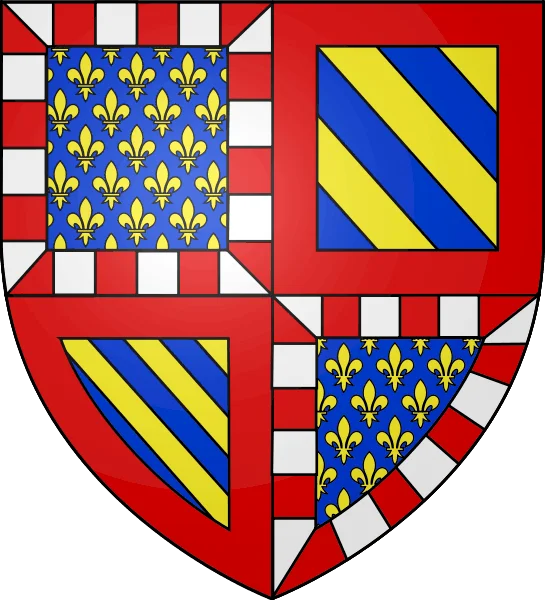
The Coat of Arms of Burgundy
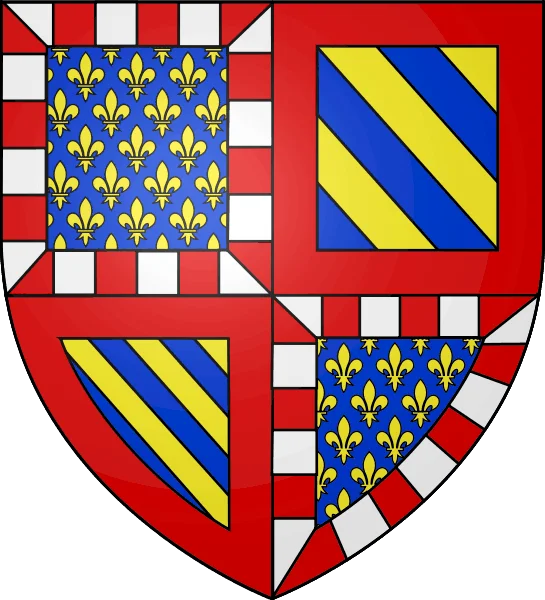
quartered, in 1 and 4 azure strewn with golden lilies with the border composed of silver and gules, and in 2 and 3 banded gold and azure with six pieces and a border of gules.
Service areas of Burgundy.

Click on the image to view the areas.