Water management
Water onboard.
We use a lot at home, but in a camper van, you have to learn to conserve it.
The tank is most often around 100 liters, used for showers, dishes, and cooking.
Water is stored in a tank that is placed out of the light, preventing algae growth.
It's necessary not to let bacteria proliferate, which would make the water hazardous to use. There are commercial products that act in this sense and allow for maintaining healthy water for a few days. (Micropur).
Under normal use, you can count on a autonomy of two or three days, which doesn't pose much of a problem regarding pollution of that water. However, the tank is not completely empty during successive fill-ups, so it is wise to plan for an antiseptic treatment.
Some use bleach (a few drops), others hydrogen peroxide.
Specific products seem to present more safety to us.
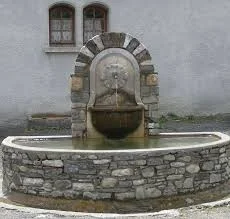
Filling up is possible in many places with potable water from the network. It is also possible to use a fountain or a river if the water is clean, but treatment with suitable products is then strongly recommended.
Conserve water for better autonomy
Running water is easy to use, but in a camper van, it's usually limited to a few dozen liters. It is therefore useful to manage your consumption as closely as possible to extend autonomy, especially when traveling in countries with few service areas.
Two consumption points represent significant usage: personal hygiene and dishes, and to a lesser extent, cleaning.
- Personal hygiene.
In the shower, lathering after lightly moistening the skin followed by a quick rinse without letting the water run unnecessarily.
Moderating the amounts of shower gel and shampoo allows for a quicker rinse.
Those who shave with a mechanical razor will save a few liters by doing so in the shower first.
Brushing teeth should be done with a dry brush for more efficiency, using a small amount of toothpaste (the size of a pea) and rinsing with a glass, which reduces consumption to its contents: 10 to 20 cl.
- Dishes
Start washing your dishes by wiping greasy and very dirty containers and utensils with absorbent paper. The process will be easier and reduces the clogging of drains and gray water tanks. Wash with a small amount of soapy water at the bottom of the sink. Wipe off the foam with absorbent paper before rinsing with a little clear water. Of course, limit dishes, utensils, and cutlery as much as possible. Very hot water is more effective than lukewarm water, and think of using what remains in your pots instead of throwing it away.
- Cleaning, especially surface cleaning, can be done with a glass cleaner, allowing you not to use water.
Laundry

The simplest is using laundromats. But if that's not possible, a kayak-style container and golf balls can make a makeshift washing machine that works by tumbling. You will just need to rinse at the end.
If your hot water takes time to arrive at the tap, collect the cold water in a container for another use.
Drinking water
Few RV users drink water from the tank even when treated, if only because of the taste associated with the plastic tank.
Mineral water or bottled tap water is a good way to drink healthy water.
Rapid stock rotation is necessary to prevent the water from spoiling, but a well-filled bottle (no air) and shielded from light can be stored without difficulty for several days. Once opened, it is advisable to store them in the refrigerator.
Disinfecting water while traveling
During travels, it is sometimes necessary to source water outside of secured sources (river, lake, or other water reserves). Depending on the regions, these waters may be contaminated by bacteria, viruses, or other parasites.
How to ensure the potability of these waters and make them safe for travelers' use.
There are several methods, but all prioritize effective filtration, as the use of disinfectants is hindered in the presence of impurities.
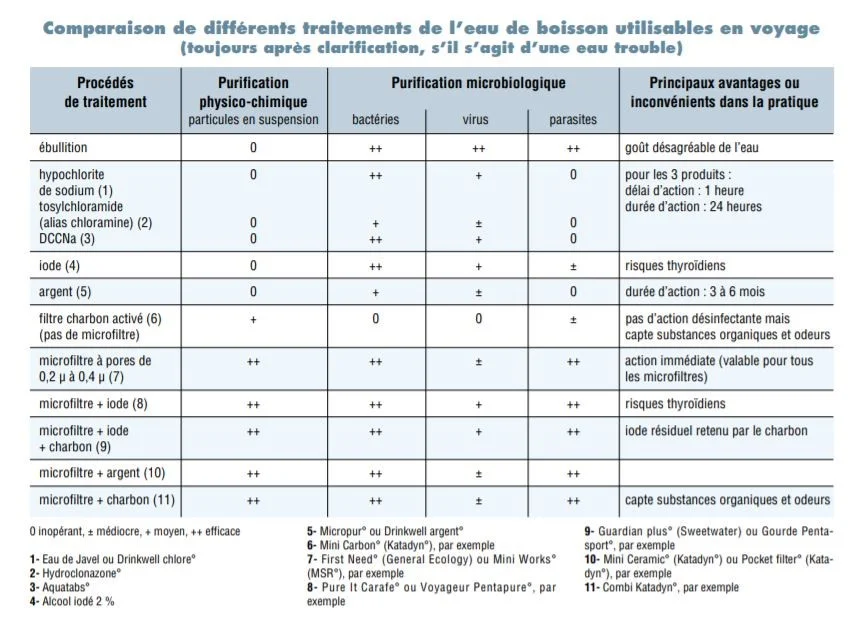
The table below gives an idea of usable products and their effectiveness according to the desired effect.
It should be noted:
* that filtering water is the most important point but not necessarily the simplest (carbon filter or micro-filters).
* that disinfection of water can be achieved quickly by using products like Aquatabs or Hydroclonazone.
* that long-term conservation in a tank is achieved with drinking water, through the use of silver salts (Micropur or Drinkwell silver).
Nomad'O to improve water autonomy
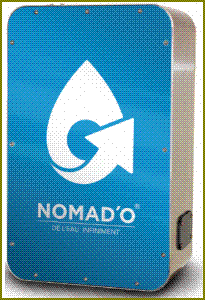
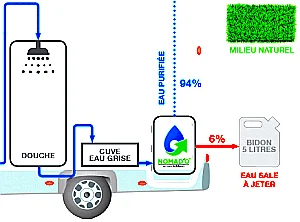
With Nomad’O, there is no longer a need to find a water tap or service area every day. This device regenerates your gray water. Dimensions H 545 x L 338 x D 200 mm; weight: 20 kg.
Nomad’O must be installed vertically and connected to the 12V power supply of the cell via a fuse and a switch.
A suction pipe (12 mm) and a ventilation pipe (6 mm) are connected to the gray water tank.
The treated water exits the device through an 8 mm pipe to reach the clean water tank.
It produces 20 to 30 liters of water per hour with an efficiency of 94%.
This treatment takes place thanks to a biological reactor, a system of ultrafiltration membranes, and reverse osmosis. The water obtained is in compliance with regulatory swimming water standards. It will therefore be reserved for external use, but the water in our tanks is not potable in the strict sense.
The power consumption is 60 W. The system is set to operate during the day when the solar panels are producing energy.
These settings are adjustable at your convenience via an application on a smartphone or tablet.
The price? €4440 in 2016.
Operating diagram
Black water (toilets) is of course not treated by this device.